


TB 117-2013 Upholstered Furniture Standard Explained

Key Facts
| Field | Detail |
|---|---|
| Standard | California Technical Bulletin 117-2013 (TB 117-2013) |
| Issued by | California Bureau of Household Goods and Services (BHGS, formerly BEARHFTI) |
| Federal adoption | 16 CFR Part 1640, enacted via the COVID-19 Regulatory Relief and Work From Home Safety Act (2020) |
| Mandatory since | June 25, 2021 (testing); June 25, 2022 (federal label) |
| Applies to | Indoor upholstered seating: sofas, sectionals, armchairs, recliners, ottomans, upholstered dining chairs, children’s upholstered seating |
| Does not apply to | Mattresses, foundations, bedding (covered by 16 CFR 1632/1633), outdoor-only cushions, certain juvenile products |
| Test type | Smoldering cigarette ignition — no open flame test |
| Ignition source | NIST SRM 1196 / 1196a standard cigarette |
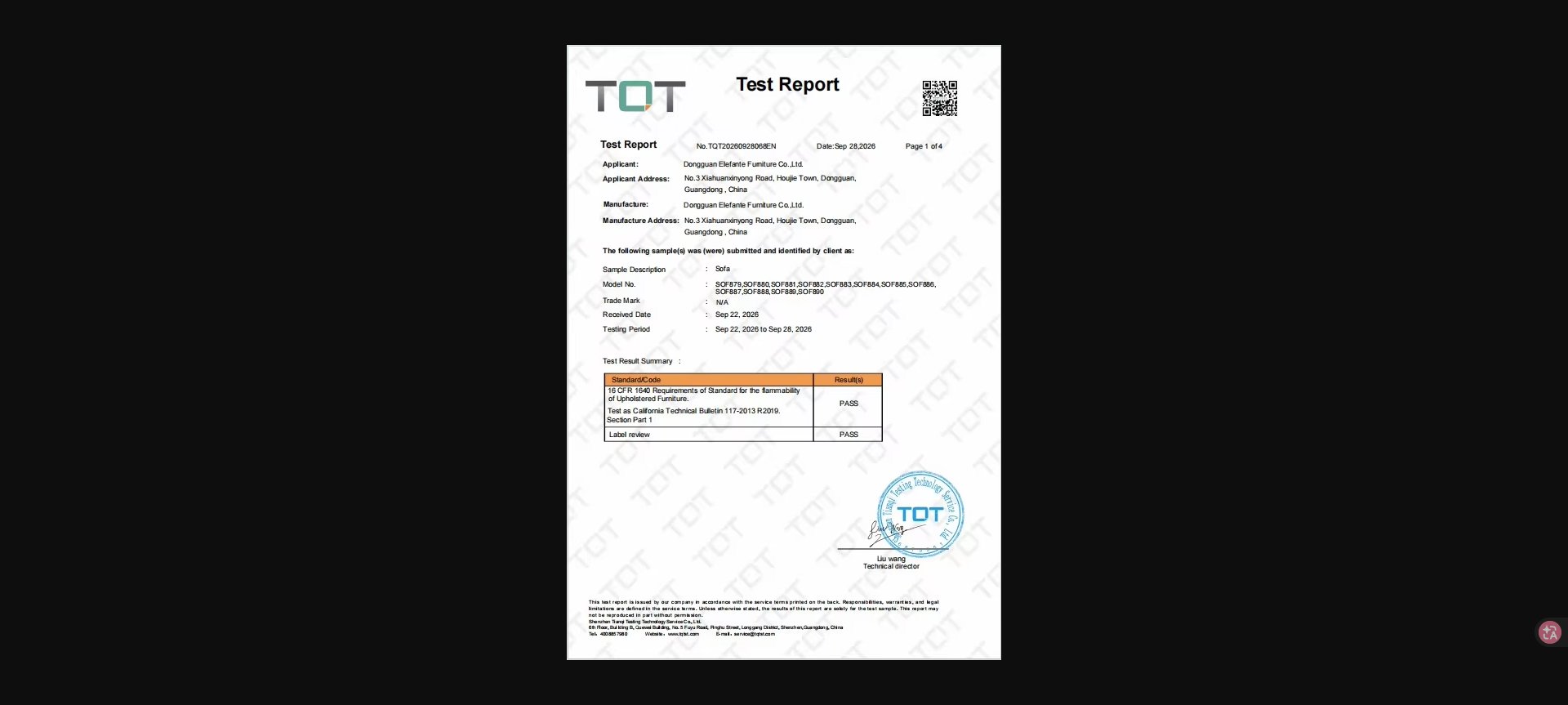
| Elefante test lab | Shenzhen Tiangi Testing Technology Service Co., Ltd. |
| Elefante report no. | TQT20260928068EN, dated 2026-09-28 |
| Flame retardant chemicals | None added — label reads “contains NO added flame retardant chemicals” |
What Is TB 117-2013?
TB 117-2013 is a set of four test methods published by the State of California in June 2013. It evaluates how the individual components of an upholstered chair or sofa react when a lit cigarette is placed on them. The four components are:
- Cover fabric (Section 1): the outermost layer, including fabric, leather, vinyl, and knit or nonwoven materials.
- Barrier material (Section 2): an optional interliner between the cover and the foam.
- Resilient filling material (Section 3): polyurethane foam, polyester fiber, down, latex.
- Decking material (Section 4): the platform under loose seat cushions.
Each component is judged on three criteria: char length, continued smoldering, and whether the smolder transitions to an open flame. If a cover fabric fails, the product can still comply by wrapping the filling in a passing barrier material.
Why Does It Exist? A Short History
The original TB 117 dates back to 1975. It required foam to survive a 12-second open flame, which in practice meant every piece of California foam was soaked in chemical flame retardants. Because California is the largest U.S. furniture market, manufacturers applied the same recipe nationwide.
Over the following decades, research linked several of those flame retardants — such as PBDEs and TDCPP — to health concerns, and studies showed that treating foam alone did little to stop real-world fires, which usually start with a smoldering cigarette on the fabric, not a flame on the foam. In 2013 California rewrote the standard around smolder resistance of the whole upholstery system and removed the open-flame foam test. The companion law SB 1019 (effective January 1, 2015) added a label stating whether the product contains added flame retardant chemicals.
In 2020, the U.S. Congress adopted TB 117-2013 as the national standard. CPSC codified it at 16 CFR Part 1640, and it took effect on June 25, 2021.
How the Test Works
The CPSC describes the ignition source as a standard cigarette meeting NIST SRM 1196 (or the equivalent 1196a). In simplified terms:
- Cover fabric test: A mock-up of fabric over standard polyurethane foam is built in an L-shaped jig. A lit cigarette is placed in the crevice and covered with a sheet of cotton. The assembly is observed for 45 minutes. It fails if the char extends more than a set length, if it is still smoldering at the end, or if it bursts into flame.
- Barrier test: Same set-up with the barrier between a standard cover fabric and foam; the barrier must prevent the foam from igniting.
- Filling test: The foam or fiber is tested under a standard cover fabric.
- Decking test: The decking material is tested with the seat cushion construction.
A product is compliant when either (a) the cover fabric and filling both pass, or (b) a passing barrier completely surrounds the filling. If decking is used, it must pass its own test.
What TB 117-2013 Does NOT Cover
- It is not a certification. There is no certificate issued by a government body; compliance is demonstrated through test reports and the permanent label.
- It does not require or prohibit flame-retardant chemicals. Many fabrics and foams pass without any chemical treatment — which is the direction Elefante follows.
- It does not cover mattresses, which fall under 16 CFR 1632 (cigarette) and 16 CFR 1633 (open flame).
- It is not an open-flame test. If a buyer asks for “match test” or “Crib 5” performance, they are referring to BS 5852 (UK) or EN 1021-2 (EU), which are different standards.
What It Means for You as a Buyer
U.S. importers: Every container of upholstered seating entering the U.S. must carry the permanent label “Complies with U.S. CPSC requirements for upholstered furniture flammability.” Hangtags and zip ties do not count as permanent. A General Certificate of Conformity (GCC) is not required for 16 CFR 1640, but you should keep the test reports on file.
Retailers and marketplaces: Amazon, Wayfair, and major retailers audit for this label and for the California SB 1019 flame-retardant disclosure. Ask your supplier for the full test report covering the exact fabric and foam combination used in your SKU — not a generic report.
Designers and contract buyers: TB 117-2013 is a residential standard. Hospitality and commercial projects often additionally require CAL 133 or NFPA 260/261. Ask before specifying.
How Elefante Complies
We test each cover fabric family and foam grade used in our sofas and chairs to TB 117-2013 Sections 1 and 3 at Shenzhen Tiangi Testing Technology Service Co., Ltd. (report no. TQT20260928068EN, dated 2026-09-28), and we retest when a fabric supplier or foam formulation changes.
Our fire performance is achieved through inherently flame-resistant cover fabric and foam selection — no additive flame retardant chemicals are used. The SB 1019 label on all Elefante U.S. seating states: “contains NO added flame retardant chemicals.”
Our U.S.-bound upholstered seating carries a combined permanent label: the federal 16 CFR 1640 compliance statement on the front, plus the California SB 1019 disclosure.
Test reports, label artwork, and a construction summary (fabric / barrier / foam / decking) are available to customers on request through our compliance team. To request documentation, contact us →
Related Standards & Common Confusion
| Standard | Market | Test type | Who it applies to |
|---|---|---|---|
| TB 117-2013 / 16 CFR 1640 | USA (all states) | Smolder (cigarette) | Residential upholstered seating |
| 16 CFR 1632 | USA | Smolder (cigarette) | Mattresses and mattress pads |
| 16 CFR 1633 | USA | Open flame, 30 min, heat release | Mattress sets |
| BS 5852 / FFFSR 1988 | UK | Cigarette + match (+ Crib 5 for contract) | Upholstered furniture |
| EN 1021-1 / -2 | EU | Cigarette / match | Upholstered furniture |
| CAL 133 | USA (contract) | Full-scale open flame | Public occupancy seating |
See our guides to 16 CFR 1633 and BS 5852.
Is TB 117-2013 required outside California?
Yes. Since June 25, 2021 it is the federal standard under 16 CFR Part 1640 and applies in all U.S. states.
Does TB 117-2013 require flame retardant chemicals?
No. The standard contains no chemical requirement. Products can pass with or without added flame retardants, and the SB 1019 label must disclose which is the case. Elefante uses no added flame retardant chemicals.
What must the label say?
A permanent label with “Complies with U.S. CPSC requirements for upholstered furniture flammability,” in English, on the front of the label, at least 1/8 inch high.
Is a GCC needed for upholstered furniture?
Not for 16 CFR 1640. Other rules (lead in paint, children’s products) may still require certification.
Does leather need to be tested?
Yes. The Section 1 cover fabric test applies to leather, vinyl, and all outermost cover materials.
How often should products be retested?
Whenever the fabric, barrier, foam, or construction changes. CPSC recommends keeping records as long as the product is in production.
Is a sofa bed tested as furniture or as a mattress?
If the mattress is detachable it follows 16 CFR 1632/1633 and the rest of the sofa follows 16 CFR 1640. If permanently attached, the whole product follows 1640.
Can I get Elefante’s test report?
Yes. Contact our compliance team and we will provide the full TB 117-2013 report (TQT20260928068EN) along with construction details.
Sources
- CPSC, Upholstered Furniture FAQ: https://www.cpsc.gov/FAQ/Upholstered-Furniture
- 16 CFR Part 1640 (eCFR): https://www.ecfr.gov/current/title-16/part-1640
- California TB 117-2013 (BHGS): https://bhgs.dca.ca.gov/about_us/tb117_2013.pdf
- California SB 1019: https://leginfo.legislature.ca.gov/faces/billNavClient.xhtml?bill_id=201320140SB1019
Last reviewed November 2026. This article is general information, not legal advice. Contact our compliance team for product-specific documentation.
Need Documentation?
We provide test reports, declarations of conformity, and Article 33 REACH declarations to verified buyers and importers.


