


BS 5852 Fire Test for Sofas & Upholstery Explained

Key Facts
| Field | Detail |
|---|---|
| Standard | BS 5852: Methods of test for assessment of the ignitability of upholstered seating by smouldering and flaming ignition sources |
| Issued by | British Standards Institution (BSI) |
| Legal basis | Furniture and Furnishings (Fire) (Safety) Regulations 1988 (SI 1988/1324), as amended; latest amendment effective 30 October 2025 |
| Ignition sources | Source 0: cigarette; Source 1: match-equivalent butane flame; Sources 2–7: wooden cribs of increasing size (Crib 5 is the common contract level) |
| Applies to | Domestic upholstered furniture in Great Britain and Northern Ireland: sofas, armchairs, sofa beds, headboards, cushions |
| Contract furniture | BS 7176 (seating) and BS 7177 (mattresses) use BS 5852 sources to define low / medium / high / very high hazard |
| Status 2026 | Regulations still in force; government consultation on a smoulder-based replacement framework closed 23 June 2026 |
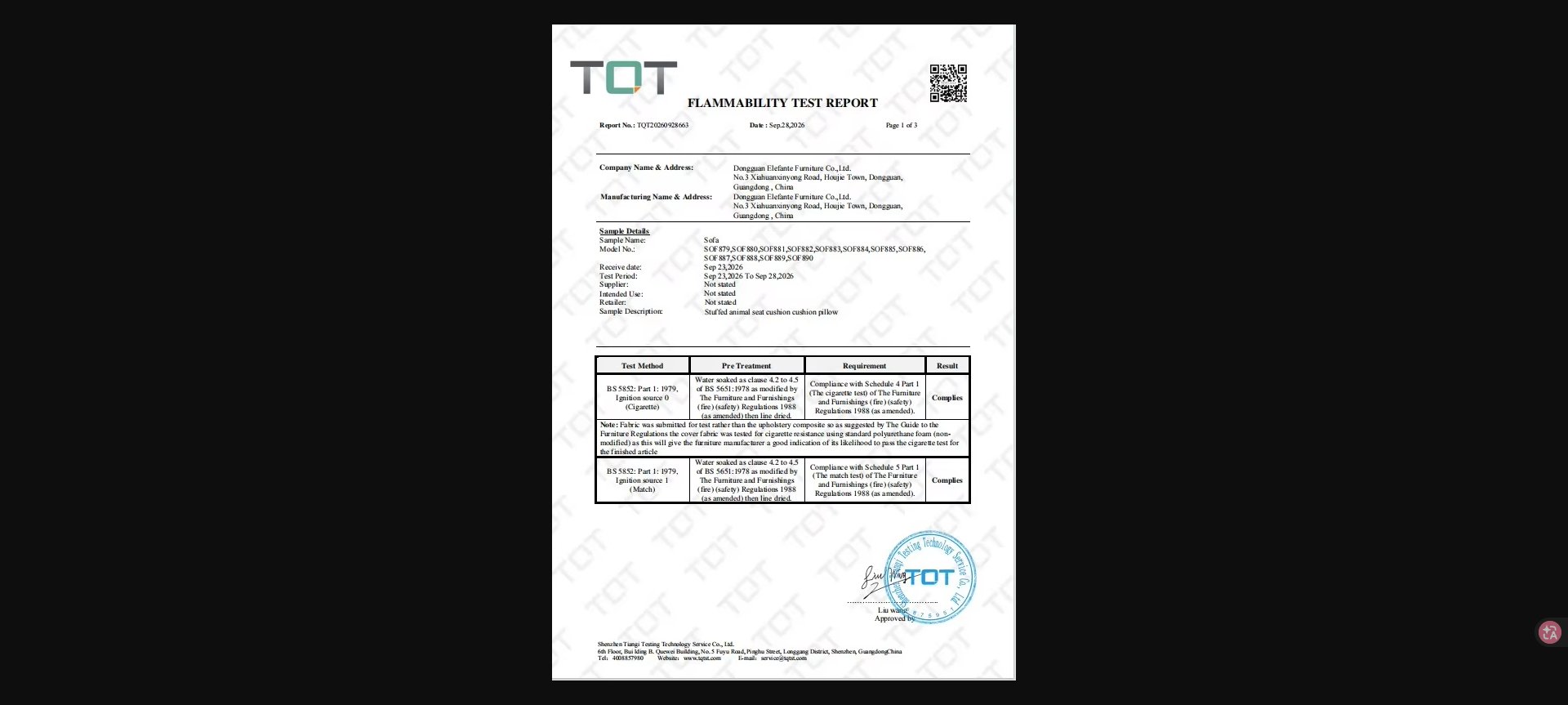
| Elefante test lab | Shenzhen Tiangi Testing Technology Service Co., Ltd. |
| Elefante report no. | TQT20260928663 |
What Is BS 5852?
BS 5852 is a laboratory method, not a law. It describes how to build a small mock-up of a seat and back from the cover fabric and filling under test, place an ignition source in the crevice, and observe whether the assembly smoulders, flames, or self-extinguishes within set time limits.
The ignition sources are numbered:
- Source 0 — a lit cigarette (smouldering ignition)
- Source 1 — a butane flame roughly equivalent to a match, applied for 20 seconds
- Sources 2 and 3 — larger butane flames
- Sources 4 to 7 — wooden cribs of increasing mass; Source 5, the famous “Crib 5”, is a 17 g crib and is the usual requirement for hotels, offices and other medium-hazard contract environments
The UK Regulations borrow specific parts of BS 5852 and set pass/fail criteria for domestic furniture.
Why Does It Exist? The 1988 Story
In the 1970s and 1980s the UK had one of the worst domestic fire death rates in Europe. Investigations repeatedly pointed to polyurethane foam sofas: once ignited they burned fast, produced thick toxic smoke, and gave occupants little time to escape. After a series of high-profile fires, Parliament passed the Furniture and Furnishings (Fire) (Safety) Regulations 1988, which:
- required fillings (foam, fibre, feathers) to pass an ignitability test,
- required cover fabrics to pass a match test (Schedule 5 Part 1), or to be used with a fire-resistant interliner,
- required the complete item to resist a cigarette (Schedule 4 Part 1),
- required a permanent label stating compliance.
Government statistics in the years that followed showed a sustained fall in furniture-related fire deaths, and the UK regime became one of the strictest in the world.
How the Tests Work
Cigarette test (Schedule 4, Part 1 / BS 5852 Source 0): The actual cover fabric and the actual filling are assembled on the test rig. A lit cigarette is placed in the junction of seat and back. The test fails if there is progressive smouldering or flaming within one hour, or if smouldering penetrates the full thickness of the filling.
Match test (Schedule 5, Part 1 / BS 5852 Source 1): The cover fabric is tested over a standard non-fire-retardant polyurethane foam. A butane flame is applied for 20 seconds. The fabric fails if flaming continues more than 120 seconds after the burner is removed, or if the assembly keeps smouldering.
Filling tests (Schedules 1 and 2): Foam is tested to Source 5 (crib) over a standard cover; other fillings (fibre, feathers, latex) to Source 2.
Crib 5 (BS 5852 Source 5, used by BS 7176 medium hazard): A small wooden crib is placed in the seat/back junction and ignited. The fabric–foam composite must not flame for more than 10 minutes, must not smoulder to destruction, and must meet mass-loss limits.
What Changed in 2025 and What Is Being Reformed in 2026
Amendment Regulations 2025 (in force 30 October 2025): The statutory guidance from the Office for Product Safety and Standards summarises the changes:
- A list of baby and children’s products (cot mattresses under 170 × 75 cm, prams, highchairs, play mats, baby nests and similar) is removed from scope, because chemical flame-retardant exposure was judged a greater risk than fire for those products.
- The display (“swing”) label requirement is removed. The permanent label under Regulation 11 remains.
- The window for bringing legal proceedings is extended from 6 to 12 months.
Reform consultation (March–June 2026): The government is consulting on replacing the 1988 framework with a smoulder-based, outcome-focused regime that reduces reliance on chemical flame retardants, similar in direction to the U.S. TB 117-2013 approach. As of November 2026 no replacement regulation has been laid; the 1988 Regulations as amended remain the legal requirement. We will update this page when the outcome is published.
What BS 5852 Does NOT Cover
- It is not a certification scheme. Compliance is evidenced by test reports, plus the permanent label.
- The domestic Regulations do not require Crib 5. Crib 5 is a contract-furniture requirement under BS 7176 medium hazard.
- It does not address smoke toxicity, which is one of the reasons the regime is being reformed.
- It is not interchangeable with EN 1021-1/-2. A fabric that passes EN 1021-2 does not automatically pass the UK match test.
What It Means for You as a Buyer
UK importers and retailers: Every in-scope item must carry the permanent label (display label no longer required since October 2025). Ask the supplier for match-test reports on the actual cover fabric, cigarette-test reports on the fabric/filling combination, and foam ignitability certificates.
Hospitality, student accommodation, healthcare: Specify BS 7176 medium hazard (Crib 5) for seating and BS 7177 for mattresses, and say so in your purchase order so the supplier uses the right fabric or interliner.
EU customers: The UK match test is stricter than EN 1021-2 in some respects; a UK-compliant sofa will generally meet EN 1021-1 and -2 but should still be tested if the fabric is new.
How Elefante Complies
Every cover fabric offered for the UK is match-tested (Schedule 5 Part 1) at Shenzhen Tiangi Testing Technology Service Co., Ltd. (report no. TQT20260928663); fabrics that do not pass natively are supplied with a Schedule 3 interliner.
The fabric-plus-filling combination is cigarette-tested (Schedule 4 Part 1); foams carry supplier Schedule 1 certificates verified through our incoming inspection programme.
For contract orders we offer Crib 5 fabric options and provide BS 7176 medium-hazard reports on request.
UK shipments carry the permanent Regulation 11 label with batch and manufacturer identification. We stopped attaching display labels after the October 2025 amendment unless a customer requests them.
We monitor the 2026 reform and will re-test to the new framework as soon as it is enacted.
To request test reports or Crib 5 documentation, contact our compliance team →
Related Standards
| Standard | Market | Test | Notes |
|---|---|---|---|
| BS 5852 | UK | Cigarette, match, cribs | Test method behind FFFSR 1988 |
| BS 7176 | UK contract | Low / medium (Crib 5) / high / very high hazard | Seating |
| BS 7177 | UK | Same hazard levels | Mattresses and bed bases |
| EN 1021-1 / -2 | EU | Cigarette / match | Different pass criteria from UK |
| TB 117-2013 / 16 CFR 1640 | USA | Cigarette smoulder only | Direction the UK reform is heading |
| 16 CFR 1633 | USA | Open flame, heat release | Mattresses |
See our guides to TB 117-2013, 16 CFR 1633 and EN 12520.
Yes. The 1988 Regulations (amended 2025) remain in force. A reform consultation closed in June 2026 but no replacement has been enacted as of November 2026.
BS 5852 ignition source 5, a 17 g wooden crib. It is the medium-hazard requirement in BS 7176 for contract seating; it is not required for domestic furniture.
No. The display-label requirement was removed from 30 October 2025. The permanent label is still mandatory.
Not automatically. The criteria differ; test to Schedule 5 Part 1 specifically.
The 2025 guidance says stock compliant with and labelled under the 1988 Regulations may continue to be sold indefinitely, provided the labelling is accurate.
Yes, loose cushions, scatter cushions sold with furniture, and upholstered headboards are in scope.
Sources
- The Furniture and Furnishings (Fire) (Safety) Regulations 1988, Schedule 5: https://www.legislation.gov.uk/uksi/1988/1324/schedule/5/part/I
- OPSS statutory guidance, Amendment Regulations 2025: https://www.gov.uk/government/publications/furniture-and-furnishings-fire-safety-regulations/furniture-and-furnishings-fire-safety-amendment-regulations-2025-uk
- SGS SafeGuardS 085/25, summary of 2025 amendment: https://www.sgsgroup.com.cn/en-cn/news/2025/06/safeguards-08525-uk-updates-furniture-and-furnishings-fire-safety-regulations
- 2026 reform consultation overview: https://wearerepairs.com/uk-fire-safety-consultation-2026-final-call/
Need Documentation?
We provide test reports, declarations of conformity, and Article 33 REACH declarations to verified buyers and importers.


