


EN 12520:2024 Domestic Seating Strength & Durability Explained

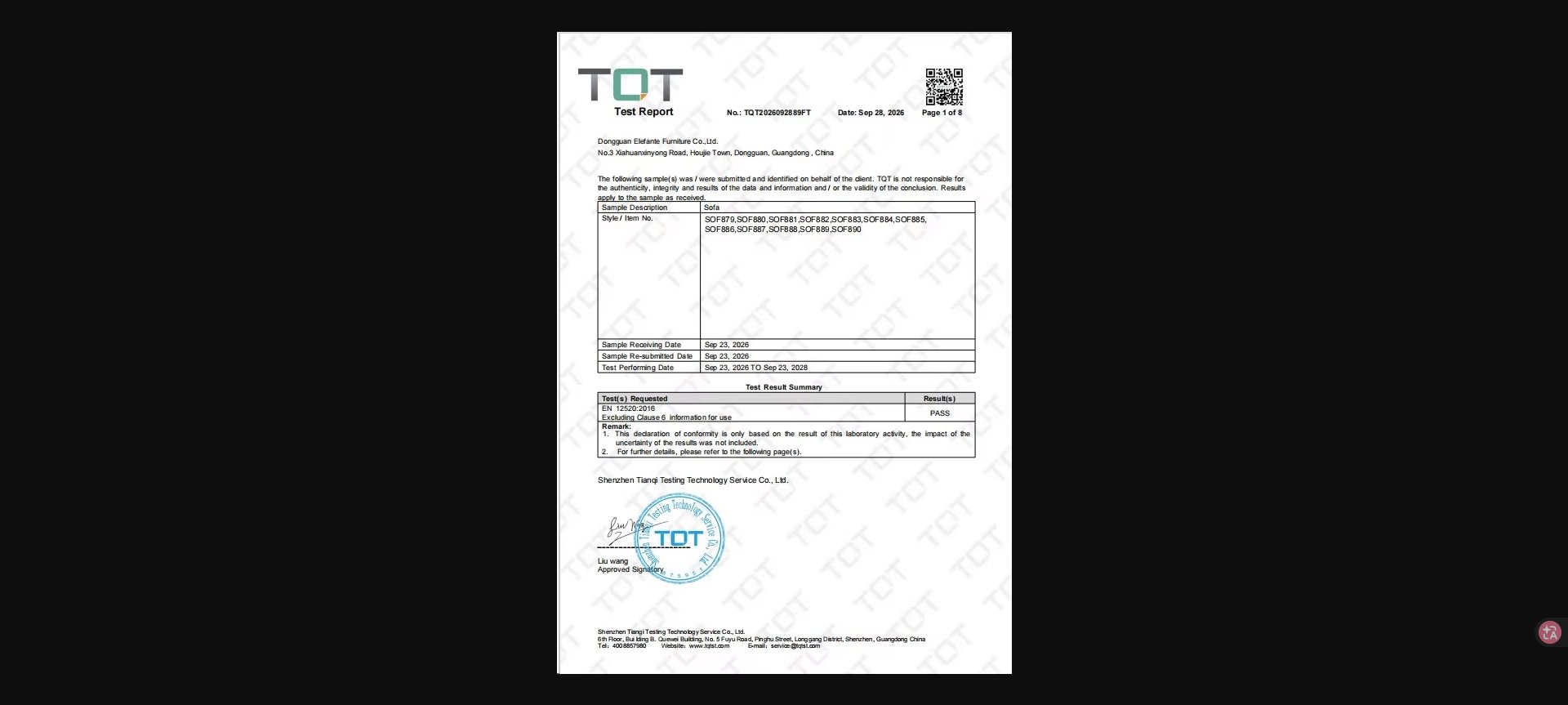
Key Facts
| Field | Detail |
|---|---|
| Standard | EN 12520 Furniture – Strength, durability and safety – Requirements for domestic seating |
| Issued by | CEN (European Committee for Standardization); adopted nationally as BS EN, DIN EN, NF EN, UNI EN, etc. |
| Current edition | EN 12520:2024 (approved September 2024; national adoption by May 2025; replaces EN 12520:2015) |
| Test methods referenced | EN 1728 (strength and durability), EN 1022 (stability), EN 13759 (operating mechanisms), CEN/TR 17202 (finger entrapment) |
| Applies to | All types of domestic seating for adults, including sofas, sofa beds (seating function), recliners, dining and occasional chairs |
| Does not apply to | Office chairs (EN 1335), contract/non-domestic seating (EN 16139), outdoor seating (EN 581), children’s furniture |
| Legal status | Voluntary harmonised-type standard; the practical route to demonstrating “safe product” under the EU General Product Safety Regulation (GPSR, EU 2023/988) |
| Elefante test lab | JieKe (Shenzhen) Testing Technology Co., Ltd. |
| Elefante report no. | JKC2026092801EN |
| Models covered | Sofa |
What Is EN 12520?
EN 12520 is a requirements standard. It says what a chair or sofa must withstand; the actual procedures are in the test-method standards it references:
- EN 1728 — strength and durability tests: static loads, fatigue cycles, impact.
- EN 1022 — stability: will it tip forwards, sideways or backwards?
- EN 13759 — durability of operating mechanisms (recliners, electrically operated seating).
- CEN/TR 17202 — finger entrapment guidance, incorporated as requirements in the 2024 edition.
A product passes when it survives every applicable test in Table 1 of EN 12520 without structural failure, loosening of joints that affects function, or creation of sharp edges and entrapment points.
Why Does It Exist?
Furniture is one of the largest product categories reported in EU injury databases: collapsing chairs, tipping sofas, pinched fingers in reclining mechanisms. Before a common standard, each country had its own tests and importers had to certify separately for Germany, France, Italy and the UK. EN 12520 (first published 2010, revised 2015 and 2024) created a single European baseline so that a sofa tested once in a CEN-accredited lab is accepted across the single market.
With the General Product Safety Regulation applying from 13 December 2024, manufacturers and importers must be able to show that a product is safe. Testing to the relevant EN standard is the recognised way to do that, which makes EN 12520 effectively mandatory for anyone serious about the European market.
How the Tests Work
Testing is performed on a complete production sample in a furniture laboratory. The main groups of tests are:
- Static load tests — a load pad applies a high force to the seat, back and arms a small number of times, simulating someone dropping heavily into the seat or sitting on an armrest. The 2024 edition raised the arm-rest downward static load from 700 N to 750 N.
- Durability (fatigue) tests — a mechanical loading rig applies seat and back loads repeatedly for tens of thousands of cycles, representing years of daily sitting. The number of cycles is set by Table 1 depending on seat type.
- Impact tests — a weighted bag is dropped onto the seat from a set height. For seats with adjustable height the 2024 edition requires five drops in both the highest and lowest positions.
- Stability (EN 1022) — forces are applied at the front edge, side and back of the seat to check that the chair does not overturn.
- Mechanism durability — reclining, swivel and electrically operated functions are cycled. EN 12520:2024 introduces a 5,000-cycle requirement for electrically operated seating in accordance with EN 13759.
- Safety and finger entrapment — gaps, shear and squeeze points are measured against the CEN/TR 17202 criteria; accessible edges and corners must be rounded.
- Single-column seating — new in 2024: a defined category (e.g. chairs with gas lifts) with its own durability tests.
What Changed in EN 12520:2024
Based on the SGS SafeGuardS summary (SG 170/24):
- Finger-entrapment requirements and test annex added (CEN/TR 17202).
- New “single column seating” category with specific durability tests.
- Table 1 test applicability revised; arm-rest downward static load increased to 750 N.
- Seat impact test now run at highest and lowest positions (five drops each) for adjustable seats.
- New 5,000-cycle durability requirement for electrically operated seating (EN 13759:2012).
- Annex D clarifies seat loading point for suspended flexible seats using a 1 kg, 70 mm cylinder.
- Products tested only to the 2015 edition should be re-evaluated, particularly electric recliners and gas-lift chairs.
What EN 12520 Does NOT Cover
- Fire performance (see EN 1021 / BS 5852 / TB 117).
- Chemical content (see REACH).
- Electrical safety of motors and power supplies (see CE marking / LVD).
- Comfort, ergonomics or foam quality beyond durability.
- Contract-use seating, which must meet the tougher EN 16139.
What It Means for You as a Buyer
EU importers: Under GPSR you are responsible for placing only safe products on the market and for keeping technical documentation. An EN 12520:2024 test report from an accredited lab is the core of that file for seating.
Retailers and marketplaces: Many large European retailers write EN 12520 into their supplier manuals. Ask whether the report is to the 2024 or 2015 edition.
Designers and hotels: EN 12520 is for domestic use. For lobbies, restaurants and student housing, specify EN 16139 Level 1 or 2 instead.
How Elefante Complies
Our core sofa and armchair frames are tested to EN 12520:2024 at JieKe (Shenzhen) Testing Technology Co., Ltd. (report no. JKC2026092801EN, covering Sofa models), using EN 1728 and EN 1022 test methods. Electric recliner models additionally complete the 5,000-cycle EN 13759 mechanism test.
We design frames using kiln-dried hardwood and engineered wood with mortise-and-tenon and dowel joinery reinforced with corner blocks, and specify foam densities that retain height after the full durability cycle count.
Finger-entrapment checks against CEN/TR 17202 are part of our design review for all reclining and folding mechanisms.
Test reports, GPSR technical documentation and our EU responsible-person details are available to importers on request. Contact our compliance team →
Related Standards
| Standard | Scope |
|---|---|
| EN 12520 | Domestic seating – requirements |
| EN 12521 | Domestic tables – requirements |
| EN 16139 | Non-domestic (contract) seating |
| EN 1335 | Office chairs |
| EN 581 | Outdoor furniture |
| EN 1728 / EN 1022 | Test methods for seating strength / stability |
| EN 1021-1/-2 | Ignitability of upholstered furniture (fire) |
See our guides to BS 5852, REACH and CE marking.
Not by itself, but under the GPSR you must prove the product is safe, and EN 12520 is the recognised way to do that for domestic seating.
EN 12520 sets the requirements and the test levels; EN 1728 describes how to perform the strength and durability tests.
Yes, in their seating function. The bed function is covered by EN 1725.
Retailers increasingly request the 2024 edition. Electric recliners and gas-lift chairs in particular should be retested because of the new requirements.
No. Fire testing is covered by EN 1021 and national regulations such as the UK FFFSR.
Yes. The UK adopts it as BS EN 12520 and it remains the reference standard.
Sources
- SGS SafeGuardS 170/24, EN 12520:2024 revision summary: https://www.sgsgroup.com.cn/en-cn/news/2024/12/safeguards-17024-european-standard-en-12520-2024-on-domestic-seating-revised
- Standards Norway, NS-EN 12520:2024 scope: https://online.standard.no/nb/ns-en-12520-2024
- CATAS, UNI EN 12520 test overview: https://catas.com/en/configurator/uni-en-12520-safety-resistance-and-durability-general-requirements-for-domestic-seating/
- EU General Product Safety Regulation (EU) 2023/988 overview: https://www.complir.io/resources/guides/gpsr-compliance-guide-product-companies
Need Documentation?
We provide test reports, declarations of conformity, and Article 33 REACH declarations to verified buyers and importers.


