


CE Marking for Furniture: Does Your Sofa Need It?

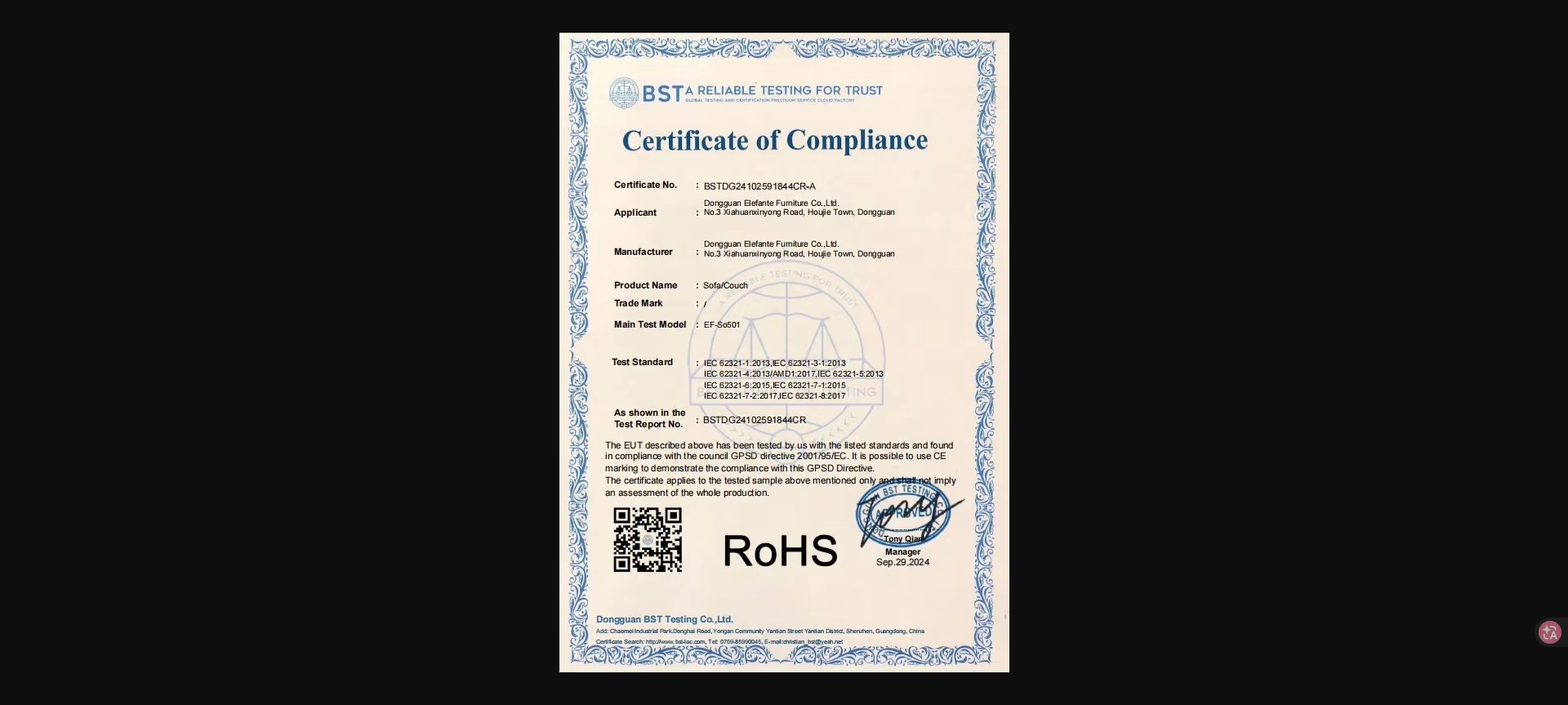
Elefante applies CE marking only to powered products. Our CE-marked sofa models are tested at Dongguan BST Testing Co., Ltd. (report no. BSTDG23102532677CR-A) to the Low Voltage, EMC, Machinery and RoHS requirements, and we maintain the technical file and EU Declaration of Conformity for each model. Non-powered sofas, chairs and tables are supplied under GPSR with EN 12520 evidence and carry no CE mark.
Key Facts
| Field | Detail |
|---|---|
| What CE is | A conformity mark affixed by the manufacturer, not a quality mark or certificate issued by the EU |
| Legal basis | Regulation (EC) 765/2008 and Decision 768/2008/EC (the “New Legislative Framework”) |
| Applies to furniture when | The product falls under at least one CE directive, usually because it has an electrical or motorised function |
| Relevant directives for powered furniture | LVD 2014/35/EU; EMC 2014/30/EU; Machinery Directive 2006/42/EC (replaced by Machinery Regulation (EU) 2023/1230 from 20 January 2027); RoHS Directive 2011/65/EU; Radio Equipment Directive 2014/53/EU if wireless charging or Bluetooth present |
| Non-powered furniture | Covered by GPSR (EU) 2023/988 — does not use CE marking |
| Key documents | EU Declaration of Conformity (DoC), technical file (kept 10 years), test reports to harmonised standards |
| Elefante CE test lab | Dongguan BST Testing Co., Ltd. |
| Elefante CE report no. | BSTDG23102532677CR-A |
| Elefante non-powered compliance | GPSR with EN 12520:2024 / EN 1725 / EN 12521 evidence |
What Is CE Marking?
The letters CE (from the French Conformité Européenne) tell market surveillance authorities that the manufacturer has:
- Identified every EU directive or regulation that applies to the product.
- Verified the product meets the essential health and safety requirements of each, usually by testing to harmonised EN standards.
- Compiled a technical file.
- Signed an EU Declaration of Conformity.
- Affixed the mark.
For most consumer products no third party is involved; it is a self-declaration backed by evidence. That is why CE is often misunderstood: it is not a certificate, it is not a quality award, and it says nothing about durability or comfort.
Why Most Furniture Must NOT Carry CE
The CE mark may only be used on products that fall within the scope of at least one CE directive. There is no furniture directive. A wooden chair, a fabric sofa or a mattress has no electrical function, is not a machine, is not a toy, and is not a construction product in the sense of the Construction Products Regulation.
Affixing CE to such products is actually a breach of EU law, because it misleads consumers and authorities. Market surveillance authorities in Germany and the Netherlands have required sellers to remove unjustified CE marks from furniture listings. If a supplier offers you “CE certified sofas” for a non-powered product, treat it as a warning sign about their compliance knowledge.
Non-powered furniture is instead regulated by the General Product Safety Regulation (GPSR), which has applied since 13 December 2024. Compliance is demonstrated with standards such as EN 12520 (seating), EN 12521 (tables), EN 1725 (beds) and EN 14749 (storage).
When Furniture DOES Need CE
| Product | Typical directives | Example harmonised standards |
|---|---|---|
| Electric recliner sofa / chair | LVD, EMC, Machinery, RoHS | EN 60335-1, EN 12520:2024 incl. EN 13759 mechanism cycles, EN 55014-1/-2 |
| Adjustable bed base | LVD, EMC, Machinery, RoHS | EN 60335-1, EN 1725, EN 55014 |
| Cabinet or shelf with built-in LED lighting | LVD, EMC, RoHS, Ecodesign | EN 60598-1 (luminaires), EN 55015, EN 61547 |
| Coffee table / nightstand with USB or wireless charging | LVD, EMC, RoHS, RED (wireless) | EN 62368-1, EN 55032/55035, ETSI EN 301 489 |
| Sit-stand desk with motor | LVD, EMC, Machinery, RoHS | EN 60335-1, EN 527-1/-2 |
Note on Machinery Regulation: Regulation (EU) 2023/1230 replaces the Machinery Directive 2006/42/EC and applies from 20 January 2027. Motorised furniture technical files will need to reference the new Regulation from that date.
How the CE Process Works for a Powered Sofa
- Scope analysis — determine applicable directives (for a mains-powered recliner: LVD + EMC + Machinery + RoHS).
- Component selection — use power supplies, motors and controllers that already carry CE and test reports; this simplifies the system assessment.
- Product testing — an accredited lab tests the complete assembly: electrical safety (insulation, earthing, temperature rise, abnormal operation), EMC emissions and immunity, mechanical safety of the moving parts (pinch points, emergency stop or battery backup for lift chairs), and RoHS material compliance.
- Risk assessment — documented per the Machinery requirements, covering foreseeable misuse (child on mechanism, trapping under footrest).
- Technical file — drawings, BOM, component certificates, test reports, risk assessment, user manual, label artwork.
- EU Declaration of Conformity — signed by the manufacturer or its EU authorised representative, listing the directives and standards applied.
- Marking and instructions — CE mark at least 5 mm high on the product rating label; user instructions in the language of each market.
What CE Does NOT Mean
- It is not proof of durability, comfort or fire performance.
- It does not replace GPSR obligations for the non-electrical parts of the furniture.
- It does not cover chemical content beyond RoHS; REACH applies separately.
- It is not accepted as-is in North America (UL / ETL / CSA). For the UK, the government confirmed indefinite recognition of CE for most product groups.
What It Means for You as a Buyer
EU importers of powered furniture: You must be named on the product or packaging, hold a copy of the DoC, and be able to produce the technical file within a reasonable time. Check that the DoC lists the LVD, EMC, RoHS and Machinery instruments and that test reports cover the complete product, not only the motor.
Buyers of non-powered furniture: Do not ask for CE. Ask instead for GPSR technical documentation, EN 12520 / EN 1725 / EN 12521 test reports, and the EU responsible-person details.
Online marketplaces: Amazon and other platforms now screen listings for unjustified CE claims. Keep the compliance category correct per SKU.
How Elefante Complies
We apply CE marking only to powered products. Our CE-marked sofa models are tested at Dongguan BST Testing Co., Ltd. to EN 60335-1 and the relevant EMC standards, with Machinery risk assessment and RoHS material testing under report no. BSTDG23102532677CR-A.
Each CE model has an EU Declaration of Conformity signed by Dongguan Elefante Furniture Co., Ltd. and a technical file retained for 10 years.
Our non-powered sofas, beds, tables and cabinets are supplied under GPSR with EN 12520 / EN 1725 / EN 12521 / EN 14749 test reports and do not carry CE.
Our Alibaba.com and website listings state the correct compliance basis per product to avoid misleading claims.
Request our DoC or technical documentation →
Related Standards and Regulations
| Instrument | Scope |
|---|---|
| GPSR (EU) 2023/988 | Baseline safety for all consumer products, incl. non-powered furniture |
| LVD 2014/35/EU | Electrical safety, 50–1000 V AC |
| EMC 2014/30/EU | Electromagnetic emissions and immunity |
| Machinery Reg. (EU) 2023/1230 | Motorised products, from 20 Jan 2027 |
| RoHS 2011/65/EU | Hazardous substances in electrical equipment |
| UKCA | UK equivalent mark; CE recognition continued indefinitely |
See our guides to RoHS, EN 12520 and REACH.
No. There is no CE directive covering non-powered furniture, and affixing CE to it is not permitted. It is regulated by GPSR instead.
Yes. It falls under the Low Voltage, EMC, Machinery and RoHS instruments and must carry CE with a Declaration of Conformity.
No. It is a manufacturer’s self-declaration backed by a technical file. Third-party “CE certificates” are test-lab documents, not EU approvals.
Yes, the lighting makes it electrical equipment under LVD, EMC and RoHS.
The UK uses UKCA, but the UK government has confirmed indefinite recognition of CE for most product categories including electrical equipment.
CE applies to products covered by specific directives (electrical, machinery, toys, etc.). GPSR is the baseline safety regulation for everything else, including ordinary furniture, and does not use a mark.
10 years after the last unit is placed on the market.
Sources
- FIRA guide, Electrically actuated furniture for the domestic market: https://fira-website.files.svdcdn.com/production/images/FIRA-Guide-to-Electrically-actuated-furniture-for-the-domestic-market-Final-v3.0.pdf
- Sicom Testing, electrified furnishings and applicable directives: https://www.sicomtesting.com/en/services/electrified-furnishings/
- EU GPSR compliance guide: https://www.complir.io/resources/guides/gpsr-compliance-guide-product-companies
- Commission GPSR guidelines C/2025/6233 summary: https://eu-representa.com/insights/gpsr-guidelines-clarifications
Need Documentation?
We provide test reports, declarations of conformity, and Article 33 REACH declarations to verified buyers and importers.


