


16 CFR 1633 Mattress Flammability Standard Explained

Key Facts
| Field | Detail |
|---|---|
| Standard | 16 CFR Part 1633, Standard for the Flammability (Open Flame) of Mattress Sets |
| Issued by | U.S. Consumer Product Safety Commission (CPSC) under the Flammable Fabrics Act |
| In force since | July 1, 2007 |
| Applies to | All mattresses and mattress sets sold in the U.S.: adult, youth, crib, bunk, futon, sofa-bed, day-bed and trundle mattresses |
| Companion standard | 16 CFR Part 1632 (cigarette smolder test for mattresses and pads) |
| Pass criteria | Peak heat release rate ≤ 200 kW at any time in 30 min; total heat release ≤ 15 MJ in first 10 min |
| Certification | General Certificate of Conformity (GCC) required; records kept for production life + 3 years |
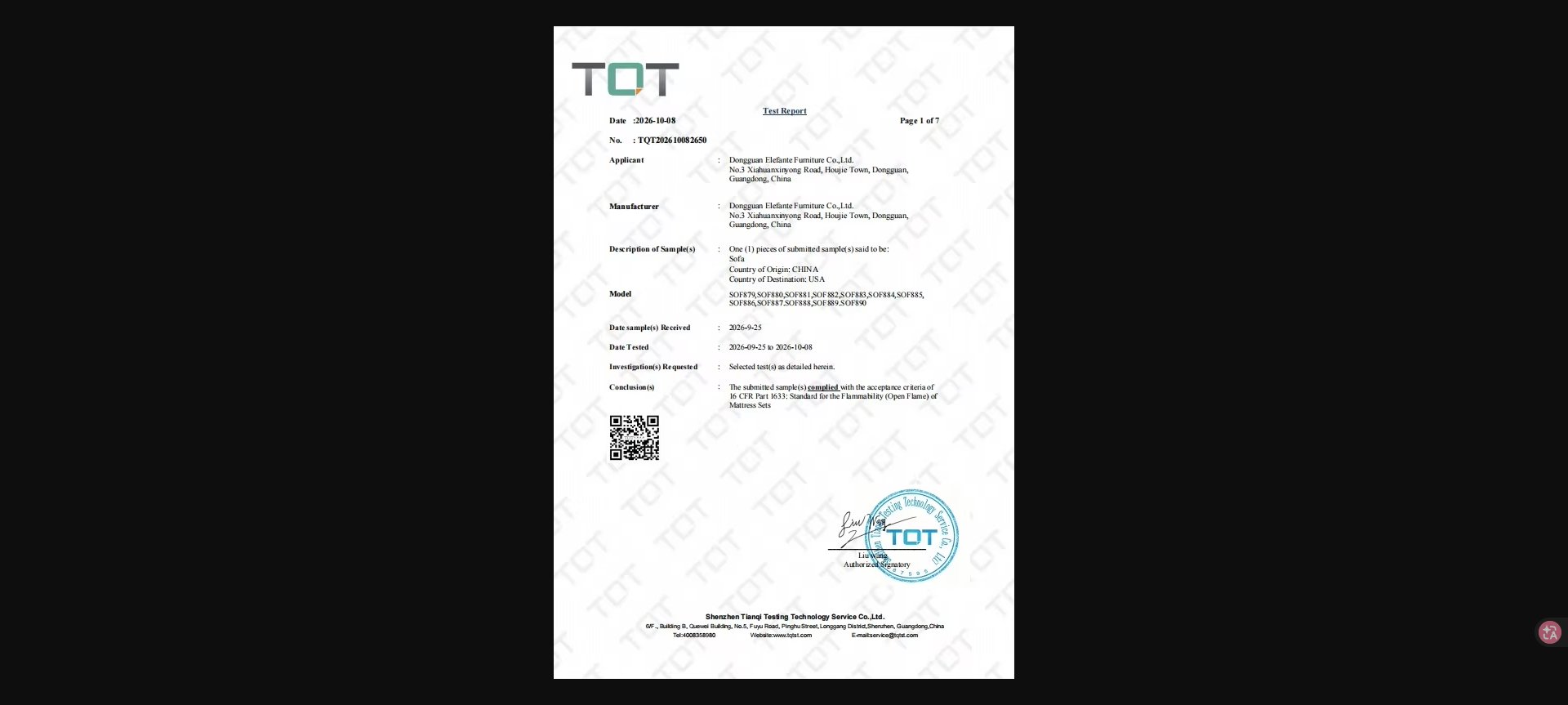
| Elefante test lab | Shenzhen Tiangi Testing Technology Service Co., Ltd. |
| Elefante report no. | TQT202610082650 |
What Is 16 CFR 1633?
16 CFR 1633 is a performance standard: it does not tell manufacturers which materials to use. Instead it sets a maximum fire size for a complete mattress set (mattress alone, or mattress plus foundation) when exposed to a pair of propane burners designed to mimic burning sheets and blankets.
It works alongside 16 CFR 1632, the older cigarette-smolder test, which limits char length to 2 inches when lit cigarettes are placed on the mattress surface. Every mattress sold in the U.S. must pass both.
Why Does It Exist?
Before 2007, the only federal mattress fire rule was the cigarette test. CPSC fire data showed that open-flame ignitions (candles, lighters, matches, especially involving children) were causing a disproportionate number of mattress fire deaths, because a burning mattress can take a bedroom to flashover in minutes.
The CPSC’s goal was simple: slow the fire enough that occupants have time to escape and firefighters have time to arrive. The 200 kW ceiling was chosen because tests showed a bedroom fire below that size generally does not reach flashover. Since 1633 took effect, mattresses in the U.S. have moved toward fire-barrier fabrics (often inherently flame-resistant yarns) wrapped around the core rather than chemical treatment of the foam.
How the Test Works
The test is run in a large fire-calorimetry room on a full-size specimen:
- Specimen: A production mattress (and foundation, if sold as a set) conditioned to standard humidity and temperature.
- Burners: Two T-shaped propane gas burners, one on the top surface and one on the side, calibrated to deliver a defined heat flux.
- Exposure: The top burner runs for 70 seconds, the side burner for 50 seconds, then both are removed.
- Observation: The mattress is left to burn for a total of 30 minutes while an oxygen-consumption calorimeter measures heat release rate continuously.
- Pass/fail: Peak heat release must stay under 200 kW throughout; cumulative heat release in the first 10 minutes must be under 15 MJ. Three specimens are tested per prototype; all must pass.
Prototype, Pooling, and Why It Matters to You
The standard is built around the concept of a prototype: a specific combination of materials, components, design, and assembly method. Once a prototype passes, production mattresses that are identical in those respects may be sold under it. A mattress sold with a foundation and the same mattress sold alone count as two separate prototypes.
For a buyer, this means: when you change the cover fabric, foam density, or add a pillow top on a private-label model, the supplier must evaluate whether that change creates a new prototype that needs retesting.
What the Label Must Say
Every mattress set must carry a permanent, conspicuous, legible label in English with:
- Manufacturer name (for imports: foreign manufacturer and importer)
- Complete physical address of the manufacturer and, for imports, the importer or U.S. location where records are kept
- Month and year of manufacture
- Model identification
- Prototype identification number
- A statement that the mattress complies with 16 CFR Part 1633
- Whether the mattress is intended for sale alone or with a foundation
What 16 CFR 1633 Does NOT Cover
- Mattress pads, toppers, pillows, and sleeping bags (pads are covered by 1632 only).
- Upholstered furniture without a mattress (covered by 16 CFR 1640 / TB 117-2013).
- Chemical content. The standard has no flame-retardant chemical requirement or restriction.
- FDA-registered medical mattresses (a narrow exemption).
What It Means for You as a Buyer
Importers: You must have a GCC for each mattress model based on prototype testing or a reasonable testing program, and the label must show your name and address as importer.
Retailers: Check that the label on the floor sample matches the prototype ID on the supplier’s test report. Ask whether the mattress is approved alone, with foundation, or both.
Hospitality and contract projects: 1633 is the baseline. Some states and institutional buyers additionally reference TB 129 or ASTM E1590 for public-occupancy bedding.
How Elefante Complies
Each Elefante mattress construction (spring unit, foam layers, fire-barrier sock, ticking) is tested as a prototype at Shenzhen Tiangi Testing Technology Service Co., Ltd. in a full-scale calorimeter to 16 CFR 1633, and to 16 CFR 1632 for cigarette resistance. Report no. TQT202610082650.
We use an inherently flame-resistant barrier fabric around the core rather than chemically treated foam.
Each shipment is accompanied by a General Certificate of Conformity referencing the prototype ID, the lab, and the test date. Labels follow the Part 1633 figure layouts for imported mattresses.
Prototype records, pooling confirmation tests, and quality-assurance records are retained for the life of the prototype plus 3 years.
Request GCC documentation or prototype details →
Related Standards
| Standard | Market | Test | Applies to |
|---|---|---|---|
| 16 CFR 1632 | USA | Cigarette smolder, char ≤ 2 in | Mattresses and pads |
| 16 CFR 1633 | USA | Open flame, 30 min, 200 kW / 15 MJ | Mattress sets |
| 16 CFR 1640 / TB 117-2013 | USA | Cigarette smolder | Upholstered furniture |
| BS 7177 / BS 5852 | UK | Cigarette, match, crib sources | Mattresses, bed bases |
| EN 597-1 / -2 | EU | Cigarette / match | Mattresses |
See our guides to TB 117-2013 and BS 5852.
No. It is a fire-performance limit. Most compliant mattresses achieve it with a barrier fabric, not by adding flame-retardant chemicals to the foam.
Yes. All mattresses must pass 1632 (cigarette) and 1633 (open flame). Mattress pads need only 1632.
Yes, for general-use mattresses. Crib mattresses are children’s products and need a Children’s Product Certificate plus third-party testing.
A unique number assigned to each tested design. It must appear on the mattress label so the product can be traced to its test records.
As long as the prototype is in production, plus 3 years.
Yes, if the mattress is detachable. A permanently attached sofa-bed mattress is treated as upholstered furniture under 16 CFR 1640.
It fails. The 200 kW limit applies at every moment of the 30-minute test.
Sources
- CPSC Mattress business guidance: https://www.cpsc.gov/Business–Manufacturing/Business-Education/Business-Guidance/Mattresses
- 16 CFR Part 1633 (eCFR): https://www.ecfr.gov/current/title-16/part-1633
- 16 CFR Part 1632 (eCFR): https://www.ecfr.gov/current/title-16/part-1632
- CPSC Laboratory Test Manual for 16 CFR 1633: https://www.cpsc.gov/s3fs-public/pdfs/blk_media_labmanual.pdf
Need Documentation?
We provide test reports, declarations of conformity, and Article 33 REACH declarations to verified buyers and importers.


