


ISO 9001 Certified Furniture Manufacturer: What It Means

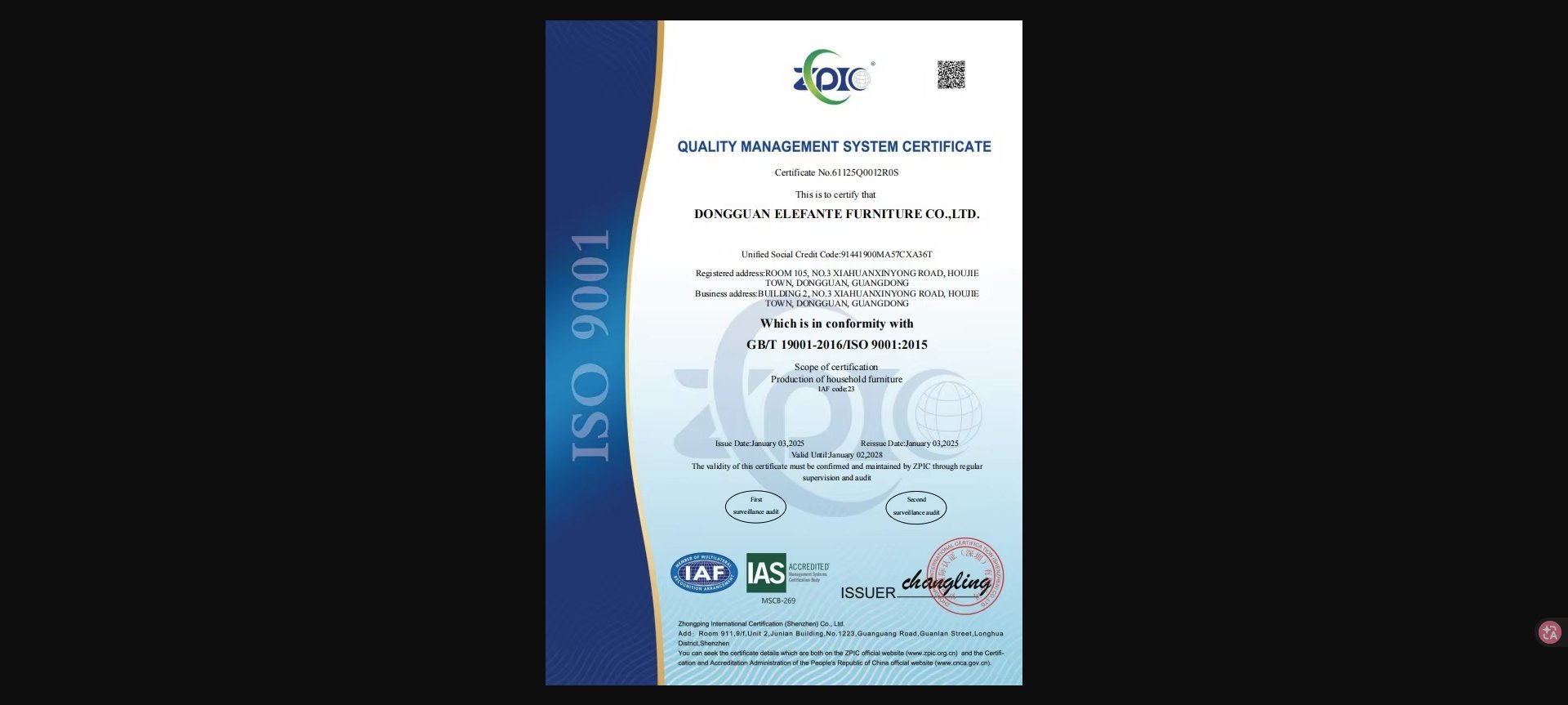
ISO published the sixth edition, ISO 9001:2026, in September 2026; certificates to the 2015 edition remain valid during the transition period ending 30 September 2029. Elefante operates an ISO 9001 certified QMS covering the design, manufacture and sale of upholstered furniture, certified by Zhongping International Certification (Shenzhen) Co., Ltd., certificate no. 61125Q0012R0S.
Key Facts
| Field | Detail |
|---|---|
| Standard | ISO 9001 Quality management systems – Requirements |
| Issued by | International Organization for Standardization (ISO/TC 176) |
| Current edition | ISO 9001:2026 (published September 2026; replaces ISO 9001:2015 and its Amendment 1:2024 on climate change) |
| Transition | Existing 2015 certificates valid until 30 September 2029; from 31 March 2028 initial certifications are issued to the 2026 edition only |
| Type of certification | Management-system certification by a third-party certification body, with annual surveillance audits and a three-year recertification cycle |
| What it covers | The organisation’s processes within the certified scope: order review, design, purchasing, production, inspection, delivery, complaints, improvement |
| What it does NOT certify | Individual product safety, fire performance, chemical content or durability (those are TB 117, EN 12520, REACH, etc.) |
| Elefante certification body | Zhongping International Certification (Shenzhen) Co., Ltd. (中平国际认证(深圳)有限公司) |
| Elefante certificate no. | 61125Q0012R0S |
What Is ISO 9001?
ISO 9001 is built on seven quality-management principles: customer focus, leadership, engagement of people, process approach, improvement, evidence-based decision making, and relationship management. The standard itself is written as ten clauses; clauses 4 to 10 contain the auditable requirements:
- Clause 4 Context — understand the organisation’s environment, interested parties and the scope of the QMS (since 2024, including whether climate change is a relevant issue).
- Clause 5 Leadership — top management accountability, quality policy, roles.
- Clause 6 Planning — risks and opportunities, quality objectives, planning of changes.
- Clause 7 Support — resources, competence, awareness, communication, documented information.
- Clause 8 Operation — the core production chapter: requirements review, design and development, control of suppliers, production control, product release, nonconforming outputs.
- Clause 9 Performance evaluation — monitoring, customer satisfaction, internal audit, management review.
- Clause 10 Improvement — nonconformity, corrective action, continual improvement.
A certificate is issued only after an accredited certification body has audited the system on site (Stage 1 document review, Stage 2 implementation audit), then re-audits annually.
Why Does It Exist?
ISO 9001 descends from military and nuclear quality specifications of the 1950s–70s, via the British standard BS 5750 (1979), and was first published internationally in 1987. The idea was to replace customer-by-customer factory audits with a single, recognised assessment of whether a supplier could consistently deliver what it promised. Today it is the most widely adopted management standard in the world, with over a million certificates across all industries.
For a furniture buyer the practical value is simple: an ISO 9001 factory has to be able to show how it checks incoming fabric, how it controls foam density, how it inspects finished sofas, what happens when a batch fails, and how customer complaints feed back into design. Without a system, those things depend on individuals; with a system, they survive staff turnover and busy seasons.
What Changed in ISO 9001:2026
Based on the published sixth edition (September 2026) as summarised by Governance Docs:
- Terms and definitions: clause 3 now defines 20 core management-system terms.
- Quality culture and ethical behaviour: new expectations in leadership (5.1.1), process environment (7.1.4) and awareness (7.3).
- Risks and opportunities split: 6.1.2 (risks) and 6.1.3 (opportunities) are now separate clauses, each with its own analysis, actions and effectiveness review.
- Management of change: clause 6.3 grows from four to seven considerations, adding communication, monitoring of effectiveness and review of results.
- Climate change: the 2024 amendment is carried into the main text of 4.1 and 4.2.
- Clause 10 renumbered: continual improvement is now 10.1 and nonconformity / corrective action is 10.2.
- Documented-information wording: “maintain” and “retain” replaced by “shall be available as documented information / as evidence of”.
In practice, a well-run 2015 system needs a climate-change determination, a quality-culture statement, a separate opportunities register and an updated change form.
What ISO 9001 Does NOT Guarantee
This is the part most marketing pages skip — and the part experienced buyers care about:
- It does not certify any product. A sofa from an ISO 9001 factory still needs its own TB 117, EN 12520 or REACH evidence.
- It does not set quality levels. The factory defines its own specifications; ISO 9001 checks that it follows and improves them.
- It does not audit every order. Certification audits sample processes and records once a year.
- It does not cover social, environmental or security performance (those are SA8000 / BSCI, ISO 14001, C-TPAT and similar).
- A certificate can be fake, expired, or issued by an unaccredited body. Always verify.
How to Verify an ISO 9001 Certificate in Three Minutes
- Ask for the certificate PDF and note the certification body, certificate number, scope statement and expiry date.
- Check that the certification body is accredited: look for the accreditation mark (e.g. CNAS in China, UKAS in the UK, ANAB in the USA) and confirm the body appears on that accreditor’s directory.
- Verify the certificate on the certification body’s online register or through the IAF CertSearch / Global ACI database.
- Read the scope. “Design and manufacture of upholstered furniture” is meaningful; “trading” or a scope that does not mention furniture is not.
- Ask when the last surveillance audit was and whether any major nonconformities were raised.
What It Means for You as a Buyer
Importers and private-label brands: ISO 9001 lowers the cost of onboarding. You can reference the factory’s documented inspection plans and AQL procedures instead of writing your own from scratch, and complaint handling will have a defined path.
Retail buyers running supplier scorecards: Use the certificate as a gate, but weight product-level test reports and on-site audit results more heavily.
Project and contract clients: ISO 9001 is often a tender prerequisite. Combine it with EN 16139 / BS 7176 product evidence for the specification.
How Elefante Runs Its Quality Management System
Certification: Certified by Zhongping International Certification (Shenzhen) Co., Ltd. (中平国际认证(深圳)有限公司), certificate no. 61125Q0012R0S, covering the design, manufacture and sale of upholstered furniture at our Dongguan facility.
Incoming inspection: Fabrics, leathers, foams and boards are checked against supplier certificates (fire, REACH, formaldehyde) and sampled per AQL 2.5 before release to production.
In-process control: Frame assembly, foam cutting, upholstery and finishing each have documented checkpoints; electrical modules on powered furniture are function-tested 100%.
Final inspection and release: Finished goods are inspected per AQL 2.5, with photographic records available to customers on request.
Nonconformity and complaints: Every customer complaint is logged, root-caused and closed with corrective action; trends are reviewed at management review.
Transition to ISO 9001:2026: We have completed a gap assessment against the 2026 edition and plan to transition at our scheduled recertification audit.
Request our ISO 9001 certificate or audit scope details →
Related Certifications
| Standard | What it certifies |
|---|---|
| ISO 9001 | Quality management system |
| ISO 14001 | Environmental management system |
| ISO 45001 | Occupational health and safety |
| BSCI / SMETA / SA8000 | Social compliance audits |
| FSC / PEFC | Chain of custody for wood |
| Product standards (TB 117, EN 12520, REACH…) | Individual product compliance |
See our guides to EN 12520, TB 117-2013 and REACH.
It means the factory has a controlled, audited system for meeting its specifications and improving. Actual product quality depends on the specifications and on product-level testing.
Yes. Certificates to the 2015 edition remain valid until 30 September 2029. New initial certifications switch to the 2026 edition from 31 March 2028.
Risks and opportunities are now handled in separate clauses (6.1.2 and 6.1.3), management of change has seven considerations, and quality culture and ethical behaviour are explicit requirements.
Annually for surveillance, with a full recertification audit every three years.
Check the certification body’s online register and the accreditation body’s directory; use IAF CertSearch / Global ACI where available.
No. Use BSCI, SMETA or SA8000 for labour and ethics audits.
Sources
- Governance Docs, ISO 9001:2026 changes, 2015 vs 2026 comparison: https://governancedocs.com/iso-9001-2026-changes/
- NQA, How to transition to ISO 9001:2026: https://www.nqa.com/en-us/resources/blog/april-2026/how-to-transition-to-iso-9001-2026
- ISO 9001 on iso.org: https://www.iso.org/standard/88464.html
Need Documentation?
We provide test reports, declarations of conformity, and Article 33 REACH declarations to verified buyers and importers.


