


REACH Compliance for Furniture Explained

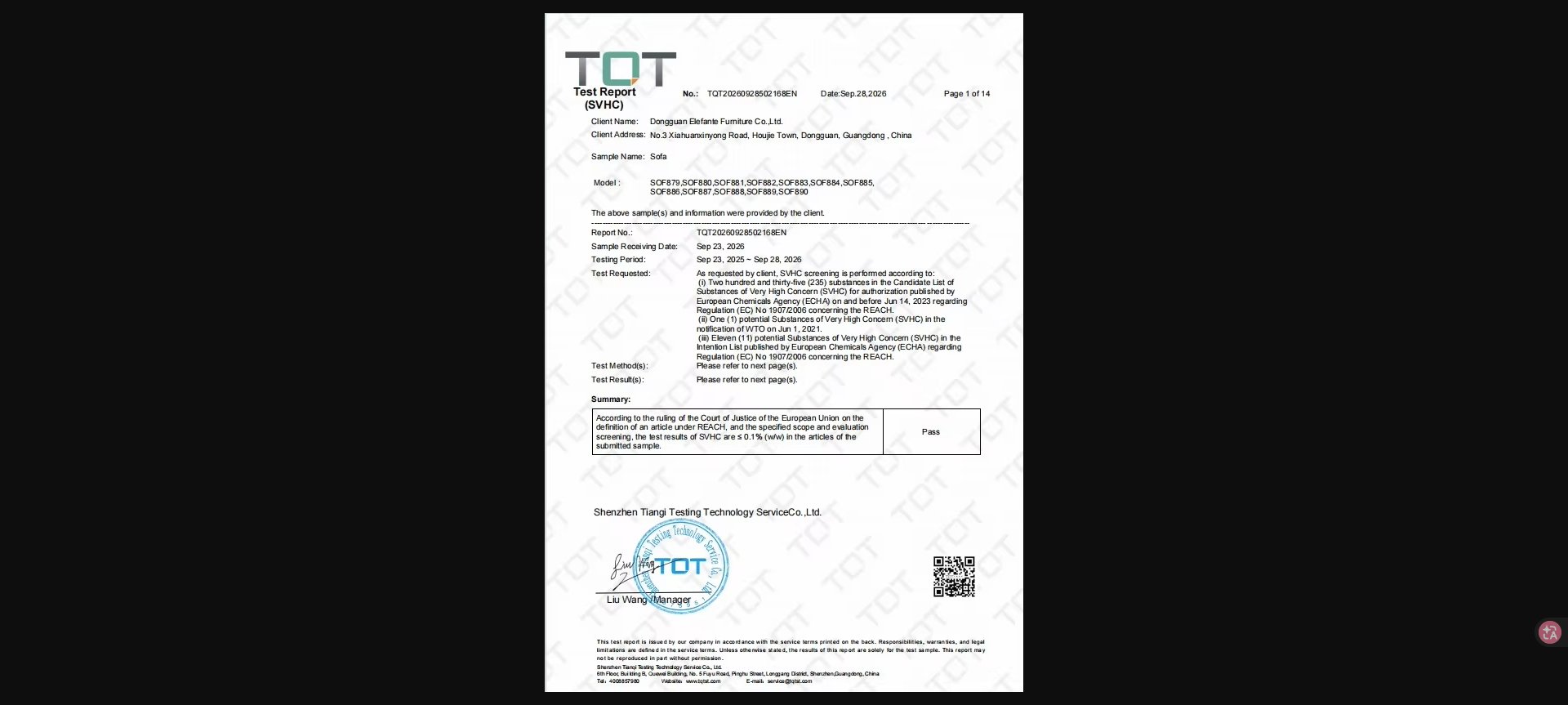
Elefante tests fabrics, leathers, foams, adhesives, coatings and hardware against the current SVHC Candidate List and Annex XVII at Shenzhen Tiangi Testing Technology Service Co., Ltd. (report no. TQT20260928502168EN) and provides REACH declarations to EU customers on request.
Key Facts
| Field | Detail |
|---|---|
| Regulation | Regulation (EC) No 1907/2006 – Registration, Evaluation, Authorisation and Restriction of Chemicals |
| Authority | European Chemicals Agency (ECHA), Helsinki; enforced by national authorities |
| In force since | 1 June 2007 |
| Applies to | Every substance, mixture and article placed on the EU/EEA market, including furniture, textiles, foam, leather, wood panels, coatings, plastics and metal hardware |
| SVHC Candidate List | 253 entries as of the 4 February 2026 update; next update expected June 2027 (ECHA) |
| Key thresholds | SVHC > 0.1% w/w in an article triggers Article 33 communication; > 1 tonne/year triggers Article 7(2) ECHA notification |
| Annex XVII | List of restricted substances with limits, e.g. azo dyes, cadmium, lead, nickel release, phthalates, PAHs, formaldehyde in articles |
| UK | Separate “UK REACH” with its own candidate list after Brexit |
| Elefante test lab | Shenzhen Tiangi Testing Technology Service Co., Ltd. |
| Elefante report no. | TQT20260928502168EN |
| Elefante board standard | E1 (formaldehyde ≤ 0.1 ppm, EN 717-1) — confirm if CARB P2 also applies to your U.S. market |
| PU leather specification | Phthalate-free (DEHP/DBP/BBP/DIBP-free) |
What Is REACH?
REACH is the broadest chemicals law in the world. Its aim is to shift responsibility for proving chemical safety from regulators to industry. The four pillars in its name:
- Registration — chemical manufacturers and importers must register substances with ECHA (this applies to the chemical, not to the sofa).
- Evaluation — ECHA and member states review the data.
- Authorisation — the most hazardous substances (SVHC) are placed on the Candidate List and may later require specific authorisation to be used.
- Restriction — Annex XVII lists substances that are banned or limited in specific uses or articles.
A furniture company is an “article producer / importer” in REACH language. Our duties are about what is inside the finished product.
What Is an SVHC and Why Does 0.1% Matter?
A Substance of Very High Concern is one that is carcinogenic, mutagenic, toxic to reproduction, persistent and bio-accumulative, or of equivalent concern (such as endocrine disruptors). ECHA adds substances to the Candidate List roughly twice a year. As of the February 2026 update the list has 253 entries.
Article 33 says: if an article contains any Candidate List substance above 0.1% weight by weight, the supplier must give the recipient enough information to allow safe use, including at least the substance name. Consumers can request this information and must receive it within 45 days.
Following the 2015 European Court of Justice ruling (“once an article, always an article”), the 0.1% is calculated per component article, not per finished product. For a sofa that means the zipper puller, the foam block, the leg, the glide, the fabric and the PU piping are each assessed separately.
Where SVHCs and Restricted Substances Hide in Furniture
| Material | Substances of concern | REACH basis |
|---|---|---|
| PU / PVC synthetic leather, piping, cable sheaths | Phthalates (DEHP, DBP, BBP, DIBP), short-chain chlorinated paraffins | Candidate List; Annex XVII entry 51/52 |
| Dyed textiles and leather | Certain azo dyes releasing aromatic amines, chromium VI in leather | Annex XVII entries 43, 47 |
| Polyurethane foam | Legacy flame retardants (TDCPP, TCEP), certain catalysts | Candidate List |
| Particleboard, MDF, plywood | Formaldehyde emissions | Annex XVII entry 77 (from 6 August 2026) |
| Metal hardware, zips, decorative studs | Lead, cadmium, nickel release | Annex XVII entries 23, 27, 63 |
| Rubber feet, glides, black plastics | Polycyclic aromatic hydrocarbons (PAHs) | Annex XVII entry 50 |
| Paints, lacquers, adhesives | Solvents, lead compounds, certain bisphenols | Candidate List; Annex XVII |
How REACH Compliance Is Verified
There is no government certificate. A credible REACH compliance programme for furniture consists of:
- Material mapping — a bill of materials listing every component article and its supplier.
- Supplier declarations — each fabric, foam, leather, board and hardware supplier declares SVHC content and Annex XVII conformity for the current Candidate List version.
- Risk-based testing — an accredited lab (ISO/IEC 17025) screens high-risk materials: phthalates in PU/PVC, azo dyes in textiles, formaldehyde emission from boards, heavy metals in coatings and hardware, PAHs in rubber and plastics.
- Article 33 declaration — a document stating either that no Candidate List substance is present above 0.1% in any component, or naming the substances that are.
- Re-screening — every time ECHA updates the Candidate List, the BOM is checked against the new entries.
What REACH Does NOT Cover
- Fire performance (see TB 117, BS 5852, 16 CFR 1633).
- Mechanical strength (see EN 12520).
- Electrical safety or RoHS substances in electrical components (see CE and RoHS; note that RoHS and REACH overlap on phthalates and heavy metals).
- Products sold only outside the EU/EEA. The UK now runs UK REACH with its own Candidate List; the U.S. uses TSCA and state laws such as California Proposition 65.
What It Means for You as a Buyer
EU importers: You are the “importer of articles” under REACH and carry the Article 33 duty towards your own customers. Ask your supplier for the Article 33 declaration referencing the Candidate List date, plus test reports for high-risk materials. Keep them for at least 10 years (Article 36).
Retailers and marketplaces: Amazon EU, Otto, Wayfair and most large retailers require a REACH declaration per SKU. Some additionally require testing of specific substance groups (phthalates, azo dyes, formaldehyde).
Specifiers and designers: For projects with sustainability certifications (BREEAM, LEED, WELL), a documented REACH programme and low-formaldehyde boards (E1 / CARB P2 / TSCA Title VI) support the credits.
How Elefante Complies
We maintain a component-level bill of materials for every collection and collect supplier REACH declarations for fabrics, leathers, foams, boards, adhesives, finishes and hardware.
High-risk materials are tested at Shenzhen Tiangi Testing Technology Service Co., Ltd. (report no. TQT20260928502168EN) for phthalates, azo aromatic amines, formaldehyde emission, heavy metals (Pb, Cd, Ni, Cr VI) and PAHs.
We issue an Article 33 declaration per order on request, referencing the Candidate List version (currently 4 February 2026, 253 entries).
Our boards conform to E1 standard (formaldehyde ≤ 0.1 ppm per EN 717-1). (If your market requires CARB P2, please specify at order stage.)
Our PU leathers are specified phthalate-free (DEHP/DBP/BBP/DIBP-free).
Our fire performance is achieved through inherently flame-resistant barrier fabrics — we do not use additive flame retardants listed as SVHC (such as TDCPP or TCEP).
When the Candidate List changes, we re-screen the BOM within 30 days and update declarations.
Request an Article 33 REACH declaration →
Related Regulations
| Regulation | Market | Relationship to REACH |
|---|---|---|
| UK REACH | Great Britain | Parallel regime with its own Candidate List (9 entries added October 2026 per SGS) |
| RoHS 2011/65/EU | EU | Restricts 10 substances in electrical equipment; overlaps on phthalates and heavy metals |
| POPs Regulation (EU) 2019/1021 | EU | Bans persistent organic pollutants such as certain brominated flame retardants |
| California Proposition 65 | USA | Warning-label law for listed chemicals |
| TSCA Title VI | USA | Formaldehyde in composite wood |
See our guides to RoHS, CE marking and EN 12520.
No. REACH compliance is demonstrated by supplier declarations and test reports. Any “REACH certificate” is a lab or supplier document, not a government approval.
253 entries as of the 4 February 2026 update. ECHA states the next update is expected in June 2027.
No. Since the 2015 ECJ ruling it is calculated per component article.
Yes, through finishes, adhesives and hardware. Untreated solid wood itself is not a concern, but lacquers and glues are.
Yes. Annex XVII entry 77 sets emission limits for formaldehyde in articles including furniture, applying from 6 August 2026.
REACH covers all articles and hundreds of substances; RoHS covers only electrical and electronic equipment and 10 substances. An electric recliner must meet both.
No. Our fire performance is achieved through inherently flame-resistant barrier fabrics, not additive flame retardants listed as SVHC.
Sources
- ECHA Candidate List of SVHC: https://echa.europa.eu/candidate-list-table
- ECHA news, Candidate List reaches 253 entries: https://echa.europa.eu/-/echa-adds-two-hazardous-chemicals-to-the-candidate-list-1
- REACH Article 33 explained: https://elektrogielda.com/index.php?controller=attachment&id_attachment=104573
- SGS SafeGuardS, UK REACH Candidate List additions (October 2026): https://www.sgsgroup.com.cn/en-cn/news/2026/10/safeguards-14226-uk-adds-nine-entries-to-candidate-list-for-great-britain
Need Documentation?
We provide test reports, declarations of conformity, and Article 33 REACH declarations to verified buyers and importers.


